Real estate agents who don’t understand buyer representation

coinsOver the holidays, I was lurking in a real estate agent’s Facebook group. They were discussing commissions in a way that might not have been legal. I left a comment about that and now I can’t find the original post. Maybe someone got worried.

Agents in the group were discussing what they do when a home buyer wants them to write an offer that is less than the asking price. Several agents said they wouldn’t do it. Others had strategies for getting the buyer to offer more.

Agents in the group expressed righteous indignation over working with buyers who don’t want to pay full price or more. Some indicated they would refuse to write the offer.

Buyer’s agents represent home buyers. It is their job to write any offer the buyer wants to make. The agent may give the buyer advice, but in the end, the buyer is the boss. Agents who represent buyers owe the buyers obedience as they have a contract with the buyers and are working for the buyers.

A good buyer’s agent will help the buyer negotiate a lower price. As hard as it is to believe, even in a seller’s market, there is room for negotiation.

In a multiple offer situation where several buyers are making an offer on the same property, the sellers will take the best offer. Usually, the best offer is the highest offer but not always. Other terms may be important to the seller. A good buyer’s agent can find out what those terms are.

When a seller gets an offer that is too low or one that they don’t like, they can accept it, reject it, or negotiate for a better offer.

Buyers don’t know what a seller will accept until they ask, and it doesn’t hurt to ask. The owners of overpriced real estate will appreciate any offer. They won’t be getting multiple offers and the property becomes an opportunity for the buyer who isn’t afraid to go below the asking price.

Always choose a buyer’s agent who will work for you, not for themselves.

Winter is a great time to test for radon

The winter months are one of the best times to test radon levels and we have lots of radon in Minnesota.

January is National Radon Awareness Month. There is a lot of misinformation out there about radon and where it could be hiding. We can not see it or feel it or hear it but that doesn’t mean it isn’t in our homes, offices, and schools.

Homebuyers should always have a radon test as part of the home inspection.  It doesn’t matter if the next-door neighbors have tested and do not have radon or if no one knows of anyone in the neighborhood who has ever had a positive radon test.

When buying or selling a house, it is recommended to have a radon test conducted by a professional. 

Most homeowners have never tested for radon, even though it is estimated that nearly half of all Minnesota an estimated 40% of homes have elevated levels of radon.

I’ll never forget the time the real estate agent told the buyers that she had never heard of radon in the neighborhood. It just doesn’t work that way.

Radon gas can be anywhere and everywhere. Radon is a colorless and odorless gas that comes from the soil. When inhaled these fine particles can damage the lungs. Exposure to radon over a long period of time can lead to lung cancer.

The average radon level in Minnesota is more than three times higher than the U.S. radon level. This is due to our geology and how our homes are operated. Minnesota homes are closed up or heated most of the year, which can result in higher levels of radon. In Minnesota, more than two in five homes have radon levels that pose a significant health risk.

Radon can be mitigated.  Sometimes, when houses have high levels of radon in them, the sellers will agree to pay for a mitigation system.

Learn more from the Minnesota Department of Health

Info graphic national radon hotline 1-800-sos-radon

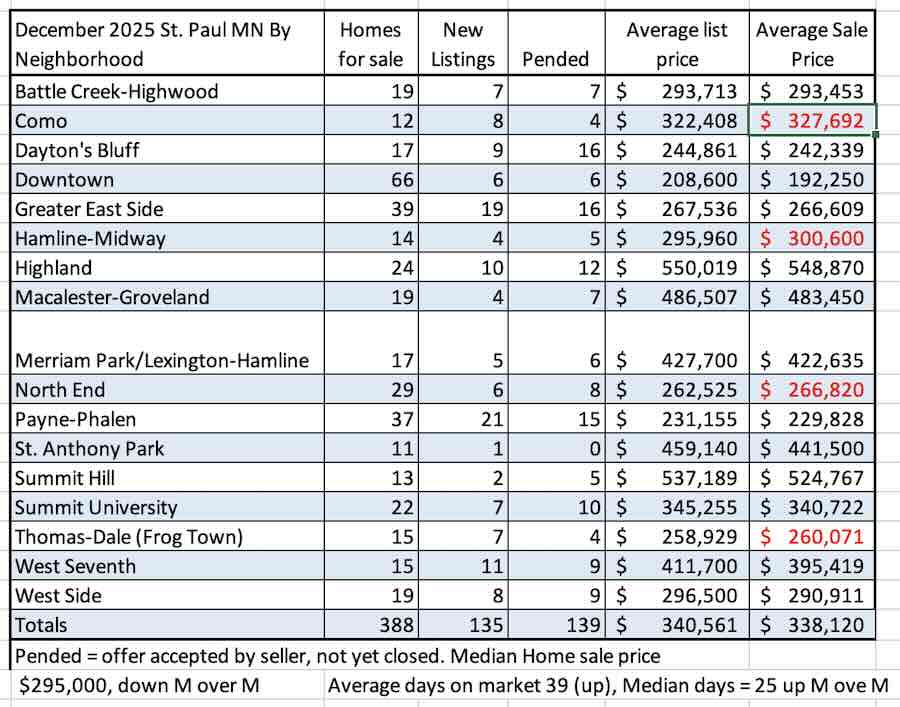
December 2025 Home Sales – St. Paul, MN

Home sales are seasonal.  The peak months are April and May. The slowest months are November and December. January is the beginning of the spring market. People who want to sell in the spring will want to get their house on the market in the next two months.

For December, pending home sales were down month over month and year over year. Prices are down slightly, which is a seasonal variation. They will go up again and peak in April and May.

Mortgage interest rates remain high. There is some uncertainty in the economy, which slows home sales. People who are concerned about their jobs do not buy or sell houses.

The data used to make the table was extracted from the NorthstarMLS and is deemed reliable but not guaranteed. The numbers are for single family houses and condos in St. Paul. The data does not include rentals or commercial property.


December Home sales
December 2025 Home Sales

Shopping in St. Paul

empty store frony
Empty storefront

We all know that small businesses are the backbone of our economy. A couple of decades ago, there was concern about big-box stores replacing small businesses. In some cases, that happened, but today even the big-box stores have left St. Paul.

I don’t recall ever having a Best Buy in St. Paul. At one point, there were a couple of Radio Shack stores.

The only big-box home store we have is Menards. There are no Lowes or HomeDepots.

There are some large grocery stores. Cub and Aldi, but we have never had a Hy-Vee.

There used to be a Kmart and a Walmart, but now there are none in St. Paul. There is no Penny’s store, and we all remember Dayton’s and Marshalls that used to be here. We had a couple of Powers stores in town and a Donaldson’s store downtown.

I don’t think we ever had a Khol’s store, but maybe we did at some point.

We never had a Joanne Fabrics, but we once had Hancock Fabrics and Minnesota Fabrics.

No Michael’s stores or Hobby Lobby’s in St. Paul, and there aren’t any of the large sporting goods stores, but there are small businesses that carry sporting goods like bikes and golf clubs. Remember “Frank’s Nursery and Crafts”; there were a few in St. Paul, and now there are none since 2004.

The last office supply store burned during the civil unrest following the brutal murder of George Floyd. I go to Eagan or order online when I need paper and toner for my business.

There was a Herberger’s in the midway area. They have been gone for a decade.

There are a couple of Target stores in St. Paul. As far as I know, they are not closing anytime soon. I stopped shopping there when they got rid of their DEI policies. My money, my choice.

These days, I do most of my shopping online and at local small businesses. Much of my clothing comes from a local thrift store. I buy my husband’s clothes at the same thrift store and through a major online retailer.

I have never been to a Costco store, and there aren’t any in St. Paul. There used to be a few shoe stores; now there is one. I have been getting my shoes online for many years.  I take a smaller size and they have always been hard to find in stores.

It isn’t at all unusual for me to have to go to a few stores before I find what used to be common household items and cleaning products. There are many big box stores in nearby West St. Paul, which is why property taxes are lower there than in St. Paul.

There are many vacant storefronts in the city. There are plenty of taprooms, bars, and breweries.  Many of the fast food restaurants are gone, but I have to say we have many wonderful restaurants.

The current administration in Washington isn’t what I would call small business-friendly.  There are tariffs, and a portion of our labor force is being deported or is denied entry into the US. Health insurance premiums are unaffordable for small businesses and workers alike. Our health insurance system and the high cost of health care act as deterrents for entrepreneurs.

Happy Shopping.